Septic tank

Septic tank

Home » Water Treatment » Septic tank

A septic tank is a primary treatment system for domestic wastewater. Through settling and anaerobic digestion it separates the solids and partially degrades the organic matter, but it does not fully purify the water.

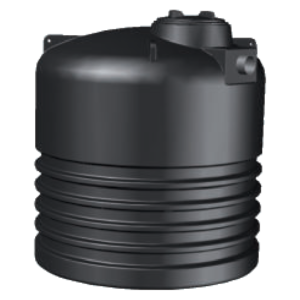
Because of its performance, a septic tank is not accepted as the sole treatment: the outlet water then needs a secondary treatment (biological filter, oxidation) or an authorised infiltration into the ground. It is the ideal solution as a pre-treatment and on plots where infiltration is permitted. At Inza we manufacture them in polyethylene and in glass-fibre reinforced polyester (GRP), from 500 to 10,000 litres, in accordance with standard EN 12566-1.

Supply: delivery time to be confirmed, depending on the size and component stock. Transport included in the price, excluding the unloading means at destination; for capacities over 5,000 L, please ask.

Questions or enquiries?

Phone: +34 91 127 90 05
WhatsApp: +34 91 127 90 05
Email: info@inzainox.com

Showing all 2 results

EXPERIENCE

We advise you before, during and after your purchase for complete satisfaction.

DESIGN

We can design and manufacture the solution you need. Tell us about your project!

SHIPPING IN 24-72h

Shipping throughout Europe. Delivery in 24-72h in mainland Spain (working days, Monday to Friday).

BUY WITH CONFIDENCE

100% secure payments. You can pay by credit card or by bank transfer with full guarantee.

We answer your questions about septic tanks

No. The septic tank only carries out a primary (anaerobic) treatment: it reduces solids but does not remove enough organic load to discharge into a watercourse. To discharge into a river or stream you need a treatment plant (full biological treatment) or, if the regulations allow it, infiltration into the ground after the tank.

The septic tank performs a primary treatment (settling + anaerobic digestion) and is not enough on its own. The treatment plant / purification station adds a secondary biological treatment and produces water suitable for discharge into a public watercourse.

Emptying and cleaning must be carried out at least once a year by an authorised waste manager, removing the sludge and floating matter from the settler-digester. After the operation, the unit is refilled with clean water.

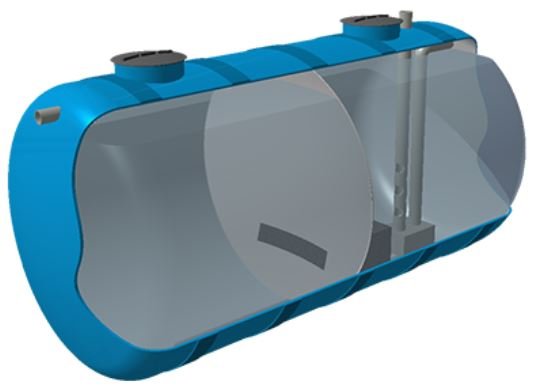
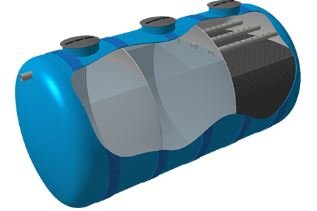
We make them in polyethylene and in glass-fibre reinforced polyester (GRP), in accordance with standard EN 12566-1. They incorporate an internal baffle, PVC connections and a Ø 620 mm threaded inspection cover.

The size is chosen by the number of population equivalents (PE): 1 PE equals the wastewater load of one person per day (about 200 litres/day and 60 g of BOD₅). In a home, the most practical approach is to count the regular occupants; to cover peaks or future expansion, a common rule is the number of bedrooms × 1.5–2 (a 4-bedroom house ≈ 6 PE).

As a guide, a septic tank needs on the order of 150 to 350 litres per PE. Our models range from 500 to 10,000 litres (from ~2-3 up to 50 PE): for a single-family home of 4–6 people a 2,000–3,000 L tank is usually enough. For non-residential uses (rural hotels, restaurants, offices, campsites) the calculation is made by places, diners or employees according to official tables.

Tip: when in doubt, choose the next size up; a generously sized unit settles better, lengthens the intervals between emptying and copes with usage peaks. If you tell us the number of users and the type of property, we will recommend the exact model.

The tank can be installed buried or above ground. Summary of the process (always follow the unit’s installation manual and the local regulations):

  • Location: accessible for the emptying tanker truck and respecting the minimum distances to wells or water catchments and to watercourses or boundaries set by your regulations.
  • Excavation (buried): a pit slightly larger than the unit, with a levelled bottom.
  • Bedding base: a compacted sand bed of 10–20 cm, well levelled. In ground with a high water table, clay or risk of uplift, a concrete slab is laid and the tank is anchored with straps to stop it floating.
  • Placement and backfill: the unit is lowered and levelled and backfilled with sand around it while it is filled with water, in layers, to balance the pressures and avoid deformation. Compact in layers and avoid stones.
  • Connections: inlet and outlet with the correct slope and levels, and an essential vent pipe to release the gases inside.
  • Inspection: the threaded cover must remain accessible at the surface (with a neck extension if the tank is deep) for maintenance and emptying.

For above-ground installations a levelled concrete base is enough and, where appropriate, securing the tank. If your ground is difficult (rock, clay, high water table), we will advise you on the additional measures.

How a septic tank works

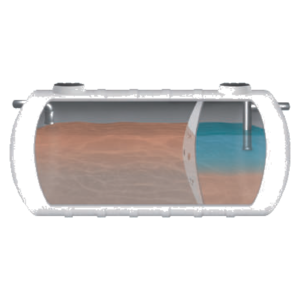
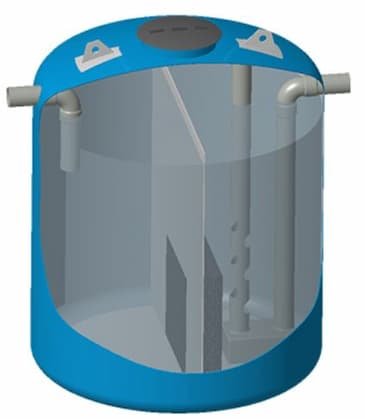
The wastewater enters the tank, where the solids settle at the bottom forming sludge and the fats float on the surface. In the absence of oxygen, the anaerobic bacteria digest the organic matter, turning it into gas and reducing its volume.

The clarified water leaves through the intermediate zone towards the secondary treatment or the infiltration. The accumulated sludge must be removed periodically by an authorised manager. An internal baffle improves separation and prevents floating matter from being carried over.
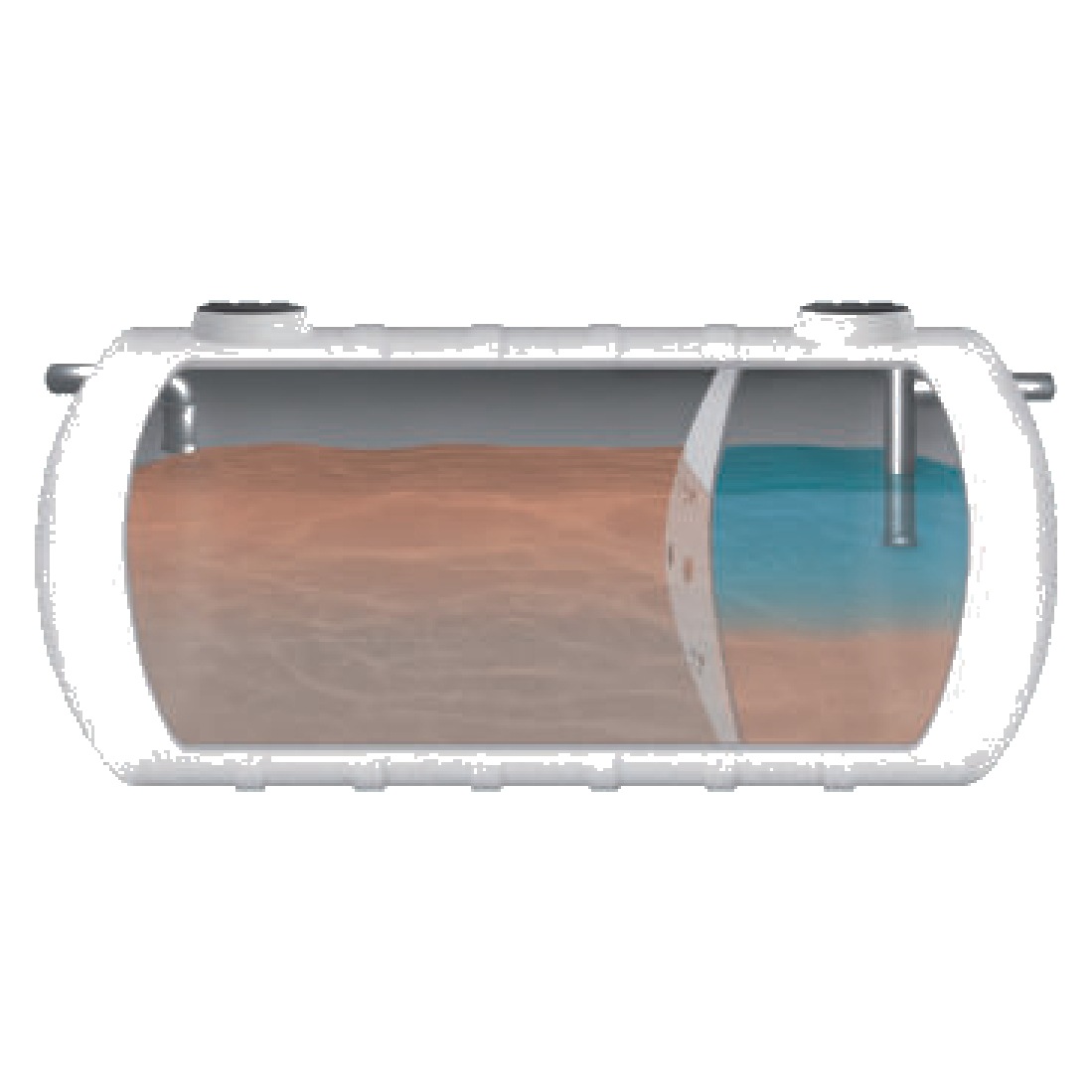
Sección de una fosa séptica

Advantages and limitations of septic tanks

Advantages

  • Simple and economical pre-treatment, with no electricity consumption.
  • Passive and robust operation, with little maintenance.
  • Retains solids, sand and fats, protecting the subsequent treatment.
  • Durable materials, resistant to corrosion (polyethylene and GRP).

Limitations to bear in mind

  • It does not fully purify: the effluent cannot be discharged directly into a watercourse.
  • It requires a subsequent secondary treatment or an authorised infiltration.
  • It needs periodic sludge emptying (at least once a year) by an authorised manager.

Why choose Inza septic tanks?

At Inza we manufacture septic tanks in polyethylene (rotational moulding) and in glass-fibre reinforced polyester (GRP), with capacities from 500 to 10,000 litres and sized by population equivalent. They incorporate an internal baffle, PVC connections and a threaded inspection cover.

They comply with standard EN 12566-1 and the Spanish discharge regulations. We advise you on combining the tank with the most suitable secondary treatment or infiltration for your plot.

Important notice: the information on this page is indicative and does not replace technical advice or the applicable regulations. Before installing any wastewater treatment system you must consult your town council, the regional government and the relevant river basin authority (Confederación Hidrográfica), since the type of treatment required, the minimum distances, the discharge authorisation and other conditions vary according to the location and each specific case. Inza advises you on the most suitable equipment, but obtaining the permits and authorisations is the responsibility of the owner of the installation.

Need help? Fill in our contact form

Seleccionar