
Water Treatment
At Inza, we specialize in efficient and sustainable solutions for wastewater and stormwater treatment. We offer a wide range of equipment designed to meet the needs of industrial, commercial, and domestic sectors.
We provide a wide variety of options: grease separators, hydrocarbon separators, decanters, septic tanks, treatment plants, tanks, pumping stations, and sampling chambers. All designed to ensure a safe, efficient sanitation system that complies with current regulations.
If you are looking for high-quality solutions for your next construction project, Inza stands out among water treatment companies for its ability to adapt to any requirement. We maintain permanent stock and offer 24-48 hour shipping.

We advise before, during, and after your purchase for total satisfaction.

We can design and manufacture the solution you need. Tell us about your project!

Shipping throughout Europe. Delivery in 24-72h in mainland Spain (working days, Monday to Friday).

100% secure payments. You can pay by credit card or bank transfer with full guarantee.
Featured Products for Water Treatment
We Answer Your Questions About Our Water Treatment Systems
What is wastewater treatment and what does it involve?
Wastewater treatment is a process by which contaminants present in used water, whether domestic or industrial, are removed to return it to the environment under safe conditions or to reuse it.
Both in water treatment companies and in domestic equipment, this process includes physical, chemical, and biological phases that eliminate solids, fats, oils, chemicals, and organic matter.
What are the types of wastewater treatment?
The main types of domestic and industrial wastewater treatment include:
- Primary treatment: separation of large solids and sediments
- Secondary treatment: biological processes to remove dissolved organic matter
- Tertiary treatment: removal of nutrients, heavy metals, and final disinfection
At Inza, we offer solutions for each treatment stage, with technologies that adapt to water characteristics and the requirements of each installation.
Why is water treatment important?
Wastewater treatment is essential to:
- Protect the environment, preventing contamination of rivers, lakes, and soils
- Comply with legal and environmental regulations
- Ensure public health, reducing the risk of diseases from contact with contaminated water
- Reuse treated water in industrial activities or irrigation, reducing potable water consumption
Thanks to their technical and user-friendly design, they facilitate installation and maintenance in demanding environments such as industrial kitchens, laboratories, and factories.
What separation methods are used in water treatment?
The most common methods in a water treatment company include:
- Decantation: gravity separation of solids and liquids
- Flotation: removal of fats and oils
- Filtration: retention of solid particles
- Hydrocarbon and grease separation: with separators specifically designed for food industries and workshops
Our equipment, such as grease separators, decanters, or pumping stations, is designed to optimize these processes and ensure effective results.
What are the differences between domestic and industrial wastewater treatment?
- Domestic wastewater: originates from homes and residential buildings. It typically contains organic matter, detergents, and food waste. It is treated with solutions such as septic tanks or compact treatment plants.
- Industrial wastewater: generated by factories, workshops, and production processes. It may contain metals, hydrocarbons, oils, and specific chemicals. It requires advanced and customized treatments, such as hydrocarbon separators, biological reactors, and discharge control systems.
Grease Separators
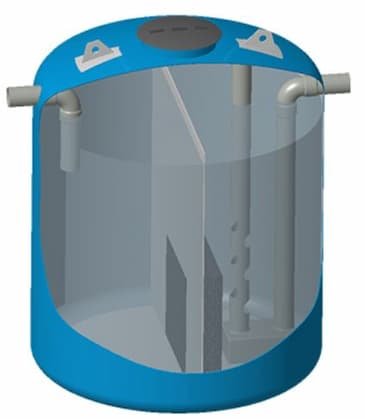
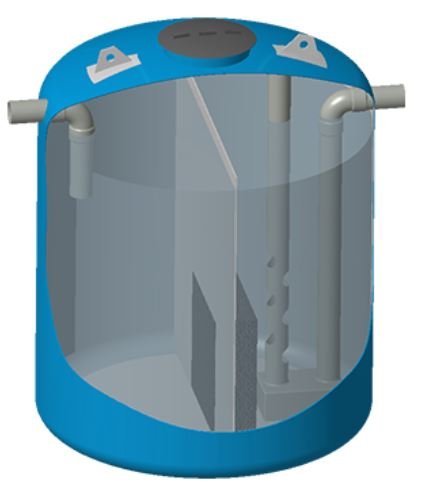
The grease separators with bodies are manufactured in fiberglass-reinforced polyester and polyethylene. They are separators with rectangular format for treatment flow rates of 0.5-4L/s and with vertical cylindrical format for flow rates of 8-22L/s
Specially designed for applications requiring a higher level of hygiene, such as restaurant kitchens. These separators can be installed above ground, buried, or semi-buried.
They are specially designed to facilitate maintenance and, due to their compact dimensions, can be installed in a cabinet under the sink. Additionally, control alarms with probes are available for monitoring grease separators.
Tanks
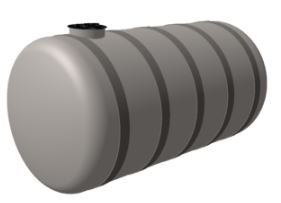
Storage tanks are manufactured in reinforced polyester and equipped with an interior barrier of sanitary isophthalic resins, suitable for containing potable water and food products.
We offer vertical and horizontal storage tanks in different sizes. These tanks can be installed above ground or buried.
Hydrocarbon Separators
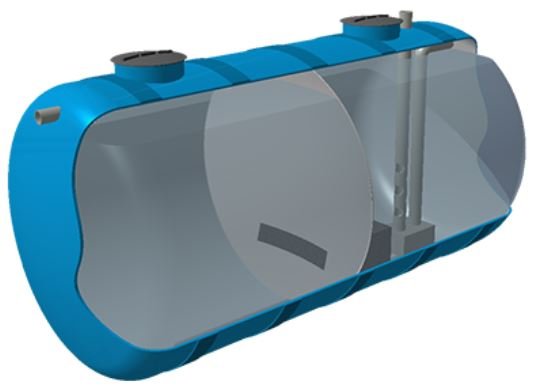
The hydrocarbon separators are manufactured with fiberglass-reinforced polyester (FRP) and polyethylene (PE) bodies.
Different configurations exist depending on their treatment flow rate. The size of the grit chamber can be small, large, or without an integrated grit chamber, because a separate grit chamber is to be installed.
There is also the possibility of manufacturing grit chambers with FRP bodies. Similarly, we manufacture hydrocarbon separators with bypass to avoid precipitation peaks in treatment.
Finally, hydrocarbon separators can be manufactured with a concrete body for installations with high water tables. These are separators specially designed to prevent flotation. Additionally, they can withstand heavy loads on their own, without the need for complicated special installations.
Control alarms with probes are available for monitoring hydrocarbon separators.
Biological Treatment Plants
Biological treatment plants are the combination of a septic tank with a biological filter, in two independent tanks or in the same tank with two compartments.
This is a biological treatment consisting of two phases. It is the most practical and effective method for treating wastewater from isolated installations not connected to public sewerage.
- Septic tank: its performance achieves 90% removal of suspended solids and reduces BOD5 by 35%, thanks to sedimentation and sludge digestion.
- Biological filter: thanks to its action, BOD5 reduction reaches up to 85%, as it oxidizes organic contaminants that the tank could not eliminate.
Total Oxidation Treatment Plants
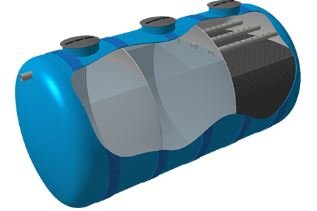
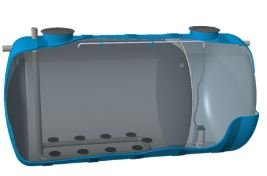
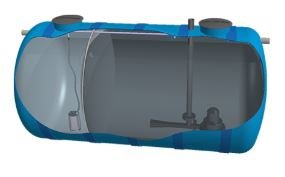
Total oxidation treatment plants guarantee a wastewater treatment system with performance exceeding that of biological treatment plants.
They consist of a compact unit that operates through three phases:
- Screening: necessary to separate coarse solids carried by the wastewater.
- Aeration phase: the wastewater is introduced into the biological oxidation chamber or biological reactor where the air supply through diffusers or an aeration pump maintains aerobic conditions and sufficient circulation to keep both microorganisms and solid particles in suspension. This mixture is distributed uniformly throughout the reactor volume, promoting their interaction. By extending this aeration over time, a nutrient-deficient situation is created where microorganisms use the cellular material of others as a food source.
- Decantation: biological sludge settles at the bottom. Using a submersible pump, this sludge is pumped back to the oxidation reactor, where it is reincorporated into the organic matter degradation process. The properly clarified and treated water overflows from the upper part of the decanter and is channeled to the discharge point.
HOW WASTEWATER TREATMENT SYSTEMS WORK
Wastewater treatment systems operate through a series of physical, chemical, and biological processes that eliminate contaminants present in used water before it is discharged back into the environment or reused. Depending on the origin and contaminant load of the water, water treatment companies apply different treatment stages.
The process can begin with solid separation using decanters, continue with the removal of fats and oils using specific separators, and culminate with biological treatments.
At Inza, we design and install wastewater treatment facilities that combine advanced technology and operational efficiency. Our systems are designed to integrate easily into domestic, commercial, and industrial environments, and are suitable for both domestic wastewater treatment and industrial water treatment.
Thanks to the automation and modular design of our equipment, we guarantee continuous, reliable, low-maintenance operation, while reducing environmental impact and costs associated with the water cycle.
Advantages of Inza Water Treatment Installations
- Robust design and high durability, with materials resistant to corrosion and weathering
- Efficient, low-maintenance technology, reducing operational costs
- Fast and simple installation, adapted to any type of space or requirement
- Compliance with European and local regulations, ensuring a safe and authorized system
Why Choose Inza Water Treatment Systems?
Because we combine experience, innovation, and environmental commitment. At Inza:
- We provide personalized advice: we analyze each case in depth to offer solutions adapted to the characteristics of the wastewater and the client’s needs, whether a small business, an industry, or a public facility.
- We comply with current regulations: all our systems are designed to comply with current legislation on the environment, discharges, and sanitation, facilitating legal compliance for our clients without complications.
- Extensive experience in industrial sectors: we have worked with companies from different industries—food, automotive, construction, etc.—developing specific solutions for industrial wastewater treatment, even in highly demanding technical environments.
- We serve projects throughout Spain: for both small businesses and large industrial facilities, with fast response times and a high level of professionalism.
Check our rates and discover how our water treatment systems can transform your project. Request your quote today!
Other products you might be interested in
Need help? Complete our contact form